
Finding Your Pace When Everything Around You Feels Too Fast
There’s a particular kind of pressure that doesn’t announce itself clearly but sounds something like this:
“I should be doing more.”
“Everyone else seems to be coping.”
“I just need to push through.”
Does this sound familiar?
Gone are the carefree days of old and in their place is a quiet, persistent fear of never doing enough.
The Problem Isn’t Your Pace
It’s easy to frame the struggle with consistency as a discipline issue. Over the past week, I have heard so many clients use the words “should” and “have to” while at the same time acknowledging their exhaustion.
But rather than seeing this as a discipline issue, I think it’s more helpful to recognise it is a mismatch issue.
A mismatch between:
- Your energy levels and your workload
- Your processing style and the environment you’re in
- Your actual needs and what you think you’re allowed to need
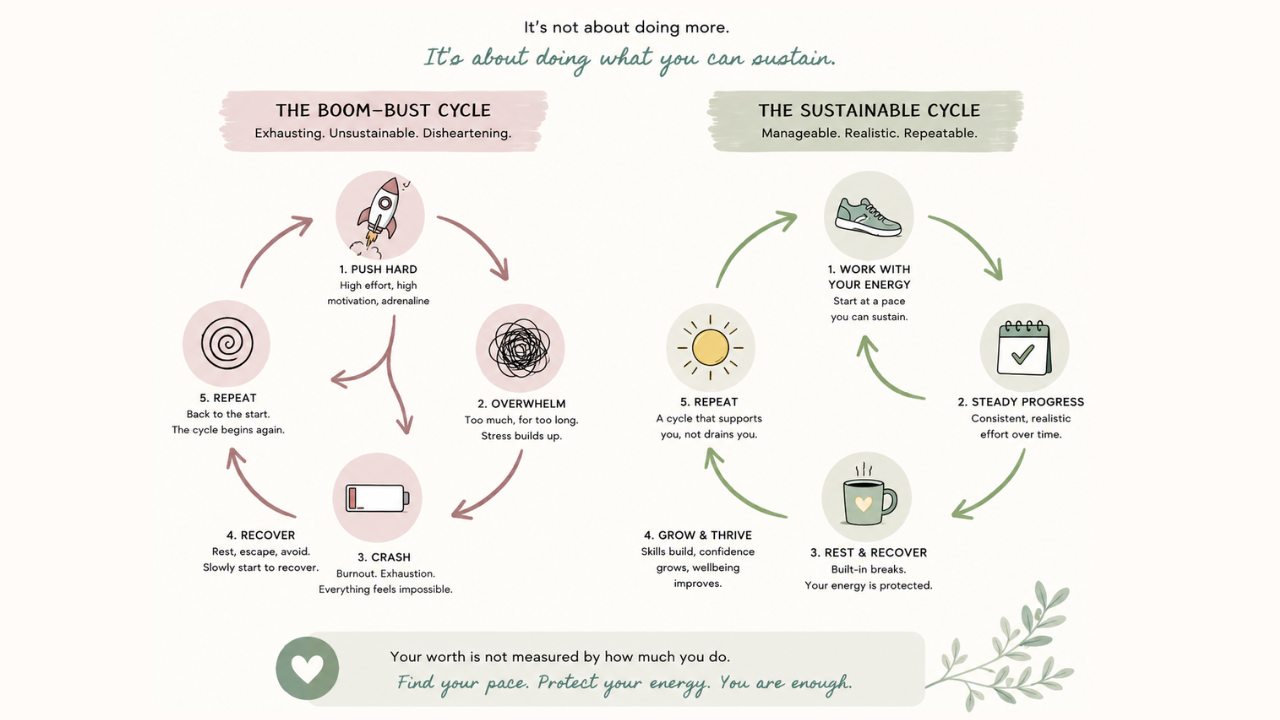
When these things don’t align, you end up in a familiar cycle:
Push hard → get overwhelmed → crash → recover → repeat
On the outside, it looks like inconsistency or low productivity.
But on the inside, it feels like exhaustion.
Why “Just Push Through” Doesn’t Work
Pushing through can work in the short term.
But it comes at a cost. You may notice:
- Increased sensory sensitivity
- Reduced concentration
- Emotional dysregulation
- Longer recovery time
And while it might look like you’re keeping up, you’re actually borrowing energy from the future.
And eventually, that debt catches up.
Finding Your Pace Isn’t About Slowing Down
“Finding your pace” doesn’t mean doing less forever or lowering your expectations to the point where nothing gets done.
It means working in a way that is:
- Repeatable (you can do it again tomorrow)
- Predictable (you know roughly what it will take)
- Recoverable (you’re not wiped out afterwards)
Practical Ways to Find Your Pace
- Work in defined chunks
Open-ended work often leads to overworking. Try setting a clear timeframe (e.g. 30-45 minutes), then stopping even if you could keep going. - Decide your “enough point” in advance
Your brain is much more likely to push past limits in the moment. Decide ahead of time what “done for today” looks like. - Track energy, not just output
At the end of the day, ask:
- How drained do I feel?
- Could I repeat today tomorrow?
- That’s more useful than measuring productivity alone.
- Build in recovery on purpose
Rest isn’t something you earn after burnout. Rest prevents it.
The Comparison Trap
One of the biggest barriers to finding your pace is comparison.
Someone else studies for six hours straight.
Someone else seems fine juggling everything.
Someone else isn’t taking breaks.
But what you’re seeing is a snapshot of someone else’s life. A life with completely different circumstances and capacity.
And building your pace based on someone else’s snapshot is like using the wrong map.
A Different Way to Measure Progress
What if progress isn’t:
- Doing more
- Going faster
- Keeping up
What if it is:
- Understanding yourself better
- Recovering more quickly
- Needing less time to reset after a hard day
- Building a way of working that actually lasts
That’s quieter progress but it’s far better in the long run.
Final Thought
Finding your pace is not a one-time decision.
It’s something you adjust as your energy, environment and demands change.
Some weeks you’ll move faster.
Some weeks you’ll need more space.
Neither is wrong.
The goal isn’t to keep up with the Jones’s (they have their own challenges).
The goal is to keep going without burning out.
And that starts with a pace that actually belongs to you.
To stopping and smelling the roses every now and then!
Linda
Linda Philips works with neurodivergent individuals and those supporting them, supporting emotional wellbeing, relationships and self-management skills. She offers individual sessions, runs a group for university students, contributes to autism assessments and provides training for businesses and organisations. If you’d like to work with Linda, you can contact her on linda.philips@autismroutemap.com or book a clarity call here.
